CCHRB Events / Programs
Regular CCHRB Meeting Annceuncement:
CCHRB meets regularly at the Petterino's Restaurant at 150 North Dearborn Street (corner of Dearborn and Randolph). Our meetings are open to our members and their previously registered alternate and/guests only.
Upcoming Meeting:
Thursday November 14, 2019 from 6:00 to 8:00 PM
(Reception begins at 5:15 PM)
Presentation Title:
50 Years of Fire Life Safety in Supertall Buildings
and
A High Voltage Upgrade that Powers Skyscrapers Higher
Presenter:
Peter Weismantle, Director of Supertall Building Technology
Adrian Smith + Gordon Gill Architecture, Chicago
Mehdi Jalayerian, Managing Director & Chief of Innovation
Environmental Systems Design, Inc., Chicago
Presentation Abstract:
50 Years of Fire Life Safety in Supertall Buildings
The evolution of fire safety concepts is discussed, starting with initial concepts developed for the “last generation” (1970s) of tall buildings in the US, to the “early” (1990s) designs in China, and from there to the explosion of supertalls currently planned in China, Asia and Middle East. Those early fire-safety concepts, using passive building elements in combination with active detection, alarm/notification and suppression have been maintained. Recognizing the effectiveness of this strategy, many locations have mandated retrofit of these active systems in existing high-rises, while maintaining requirements for passive protection. As international design teams participated in the development of high-rise structures around the world, many of the concepts of fire-safe design first introduced in the US have been adopted, amended and otherwise modified to become global design standards. This process has been a joint effort of the architects and the fire engineers involved in supertall building design. Early adoption of and reliance on active fire suppression systems and the application of performance-based design, expert panels, peer review and special studies to validate building performance have evolved into standard practices worldwide. Although codes vary significantly between the US, Asia and Middle East; the overall fire-safety strategies, and the use of performance-based design tools to demonstrate compliance is used commonly on projects in all locations. For example, modeling is routinely used to demonstrate safe egress in cases where strict compliance may not be feasible. As the community of high-rise design specialists, contractors and operators carries out projects around the world, shared experience has fostered advances in high-rise fire safety and the practice of fire safe high-rise design worldwide.
A High Voltage Upgrade that Powers Skyscrapers Higher
Imagine a day in the recent past, when modern skyscrapers were impossible, because power systems on the ground could only reach 30-40 stories high. What changed? In the 1960s, the Chicago Board of Trade wanted to update infrastructure to add more power density to its higher floors, yet feeders from the transformers on the ground floor couldn’t distribute beyond 200 feet (61 meters). Seemingly, the power expansion in the 1920s-era building couldn’t be executed in the absence of revolutionary ideas. While working with a Chicago-based utility to figure out how to put transformers on upper floors, Hem Gupta sketched out a plan that had never been tried before. The high voltage power system innovation, which included 12Kv electrical risers, not only worked, but it dramatically increased electrical energy capacity in the building, and paved the way for a revolutionary approach to efficiently power future tall buildings. Today, transformers rest at numerous points vertically in skyscrapers throughout the world, configured as stacked 30-40 story high-rises to form segmented tall buildings. Dubai once had a building code that disallowed high-voltage risers. Once officials were convinced of the importance of revising this code, Dubai became the site of the world’s tallest building. The high-voltage upgrade from the late 1960s has evolved to become the industry standard, and has greatly helped tall buildings not only to exist, but to enjoy a reliable and economical electrical infrastructure. An innovation from 50 years ago promises to keep skyscrapers rising higher for the next 50 years
Presenter's Bio:
CCHRB Annual Seminars:
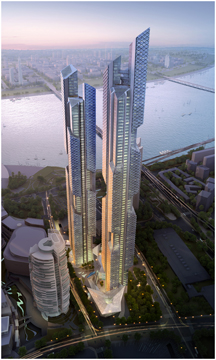
Aerial of Yongsan Towers
Architect: Adrian Smith and Gordon Gill
© Adrian Smith + Gordon Gill Architecture

Chicago Committee on High Rise Buildings